Every event starts with a goal.
Whether you're organizing a university camp, conference, exhibition, workshop, or networking event, success should be measured by more than just whether the event happened.
That's why EventLink allows you to set measurable goals during event setup and automatically tracks progress throughout the event lifecycle.
Why Set Event Goals?
Goals help your team stay aligned on what matters most.
Instead of asking:
- "How did the event go?"
- "Did people enjoy it?"
- "Was it worth the effort?"
You can answer with real data. And these outcomes can be tracked directly inside your EventLink workspace.
Examples:
- 500 attendees joined the event
- 80% attendance rate achieved
- $10,000 ticket revenue generated
- 1,200 professional connections exchanged
- 92% attendee satisfaction score
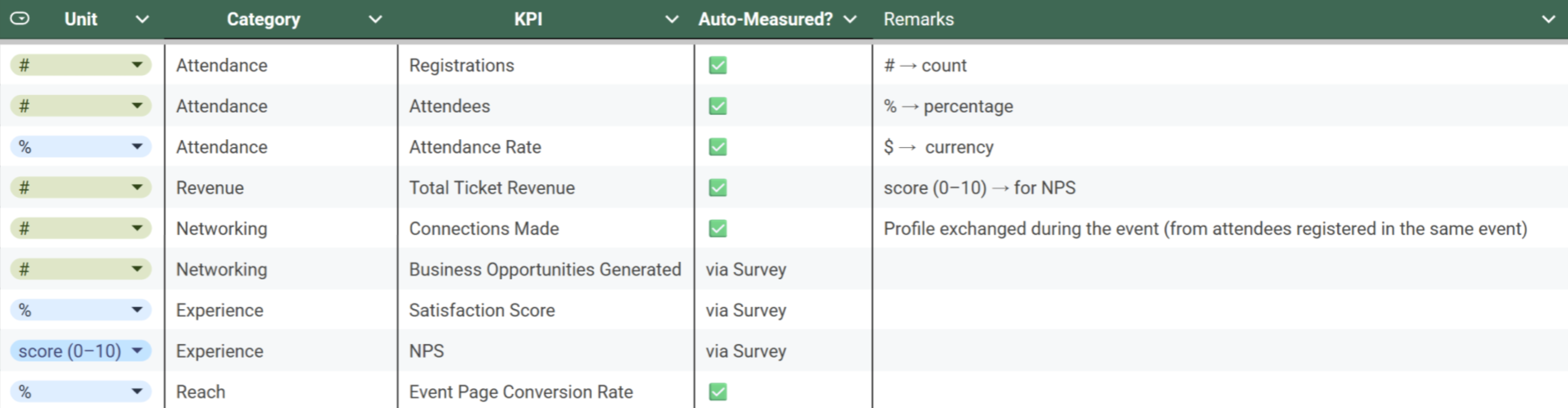
Let’s Understand Event Goals Better
Attendance
Registrations
The total number of people who registered for your event.
Useful for:
- Marketing performance
- Demand forecasting
- Venue planning
Auto-measured: Yes
Attendees
The number of participants who actually attended.
Useful for:
- Event reach
- Audience growth
- Sponsor reporting
Auto-measured: Yes
Attendance Rate
Measures how many registered participants showed up.
Formula:
Attendance Rate = Attendees ÷ Registrations × 100
Example:
- 500 registrations
- 400 attendees
Result:
80% attendance rate
Auto-measured: Yes
Revenue
Total Ticket Revenue
Tracks the total revenue generated from ticket sales.
Useful for:
- Financial reporting
- Budget planning
- ROI measurement
Auto-measured: Yes
Networking
Connections Made
Measures the number of attendee-to-attendee profile exchanges completed during the event.
This helps organizers understand whether meaningful networking actually happened.
Examples include:
- Business card exchanges
- Profile sharing
- Contact sharing through EventLink
Auto-measured: Yes
Business Opportunities Generated
Measures the number of potential partnerships, sales leads, collaborations, or opportunities reported by participants after the event.
Examples:
- Qualified sales leads
- Partnership discussions
- Investor introductions
- Recruitment opportunities
Auto-measured: Via post-event survey
Experience
Satisfaction Score
Measures how satisfied attendees were with the event experience.
Collected through attendee feedback surveys.
Examples:
- Venue quality
- Session quality
- Networking experience
- Overall event satisfaction
Auto-measured: Via survey
Net Promoter Score (NPS)
Measures attendee loyalty and likelihood to recommend your event.
Participants answer:
"How likely are you to recommend this event to a friend or colleague?"
Score range:
0–10
NPS is widely used by professional event organizers to benchmark event quality.
Auto-measured: Via survey
Reach
Event Page Conversion Rate
Measures how effectively your event page converts visitors into registrations.
Formula:
Conversion Rate = Registrations ÷ Event Page Visitors × 100
Example:
- 2,000 page visitors
- 400 registrations
Result:
20% conversion rate
Useful for:
- Marketing campaigns
- Landing page optimization
- Registration performance
Auto-measured: Yes
Choosing the Right Goals
Different event types require different success metrics.
Conferences
Recommended goals:
- Attendees
- Attendance Rate
- Satisfaction Score
- NPS
Exhibitions & Trade Shows
Recommended goals:
- Attendees
- Connections Made
- Business Opportunities Generated
- Ticket Revenue
Networking Events
Recommended goals:
- Attendees
- Connections Made
- Satisfaction Score
- Business Opportunities Generated
Student Events
Recommended goals:
- Registrations
- Attendance Rate
- Satisfaction Score
- NPS
Focus on Outcomes, Not Activities
Many event teams measure success based on completed tasks.
But attendees don't remember task completion.
They remember:
- Whether they attended
- Whether they met valuable people
- Whether they learned something useful
- Whether they would come back again
EventLink helps organizers focus on the outcomes that matter most by automatically collecting event data and turning it into actionable insights.
Because the best events aren't just well-organized—they achieve their goals.